PLANT HEALTH CARE | ADVANCED TREE RISK ASSESSMENT | PEPIN, WI
Introduction
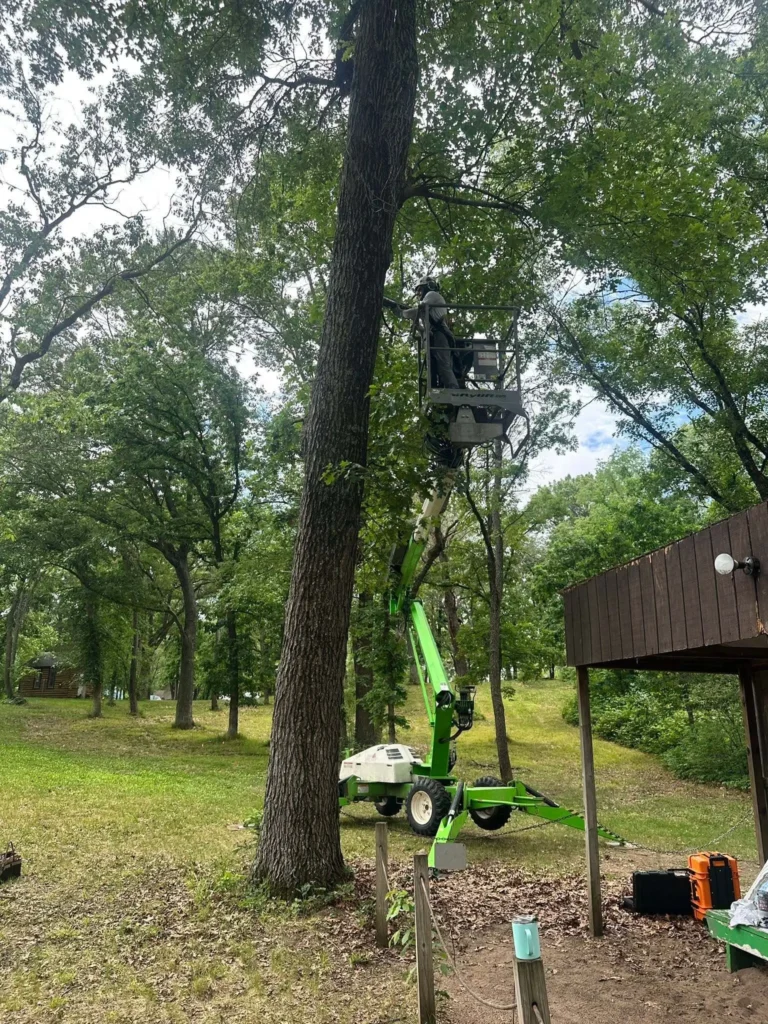
Some trees carry more responsibility than others. At YMCA Camp Pepin in Pepin, Wisconsin, a mature red oak stands at the center of an active archery range and serves as a structural anchor point for the camp’s zipline system. Every season, children and adults pass beneath its canopy and attach equipment to its trunk. That combination of factors called for more than a visual inspection. It called for a plant health care assessment at the highest level the arboricultural profession offers.
ArborWise Tree Management was contacted to perform a Level 3 Advanced Tree Risk Assessment on this tree. The work required specialized diagnostic technology, ISA Tree Risk Assessment credentials, and the interpretive expertise to translate raw data into a written report that camp administrators can rely on.
This blog walks through what that process looks like, why it matters, and what property owners and facility managers should understand about advanced tree risk assessment in the Driftless Area of western Wisconsin and southeastern Minnesota.
What Is a Level 3 Advanced Tree Risk Assessment?
A Level 3 Advanced Tree Risk Assessment is the most thorough evaluation available in professional arboriculture. The International Society of Arboriculture defines three levels of tree risk assessment, each increasing in depth and technical requirement.
- Level 1 is a limited visual assessment, typically a walk-by survey used to flag obvious hazards across a large population of trees.
- Level 2 is a basic assessment, a detailed visual inspection of the whole tree from ground level. This is the most commonly performed evaluation.
- Level 3 is an advanced assessment, reserved for situations where Level 2 findings are inconclusive or where the consequences of failure demand a definitive, documented answer.
At YMCA Camp Pepin, the site conditions made a Level 3 assessment the only appropriate choice. A large-diameter red oak with mechanical load applied to its trunk, directly above a high-use public recreation area, required internal diagnostic data, not just a visual opinion.
How Sonic Tomography Reveals What Eyes Cannot See
The core diagnostic tool used in this assessment was the Arbotom sonic tomography system. This is professional-grade equipment that maps the internal condition of a tree trunk without any invasive cutting or coring.
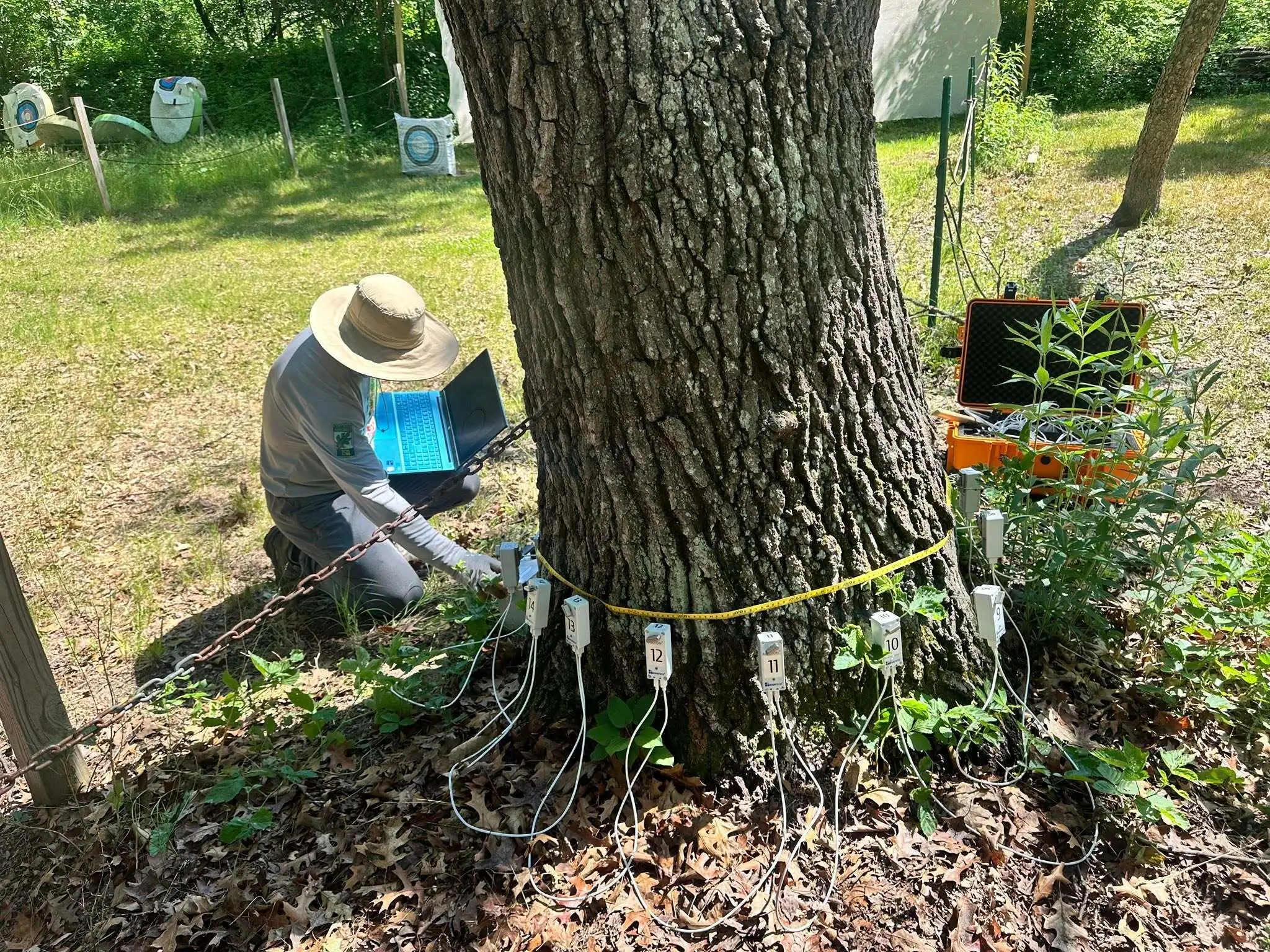
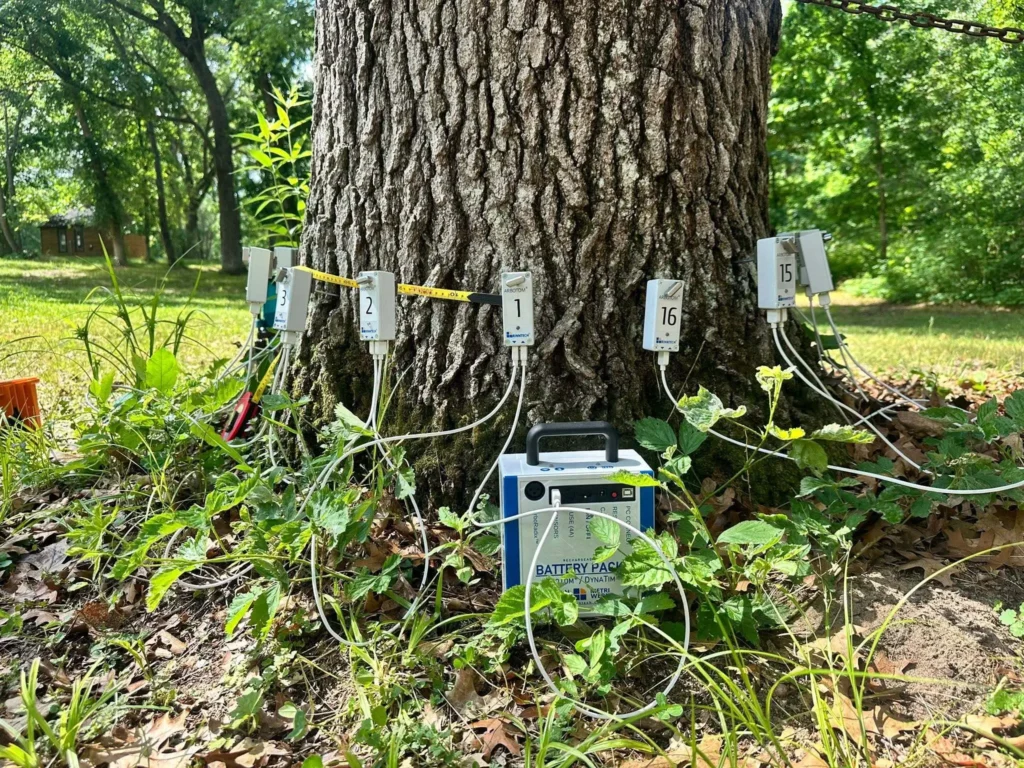
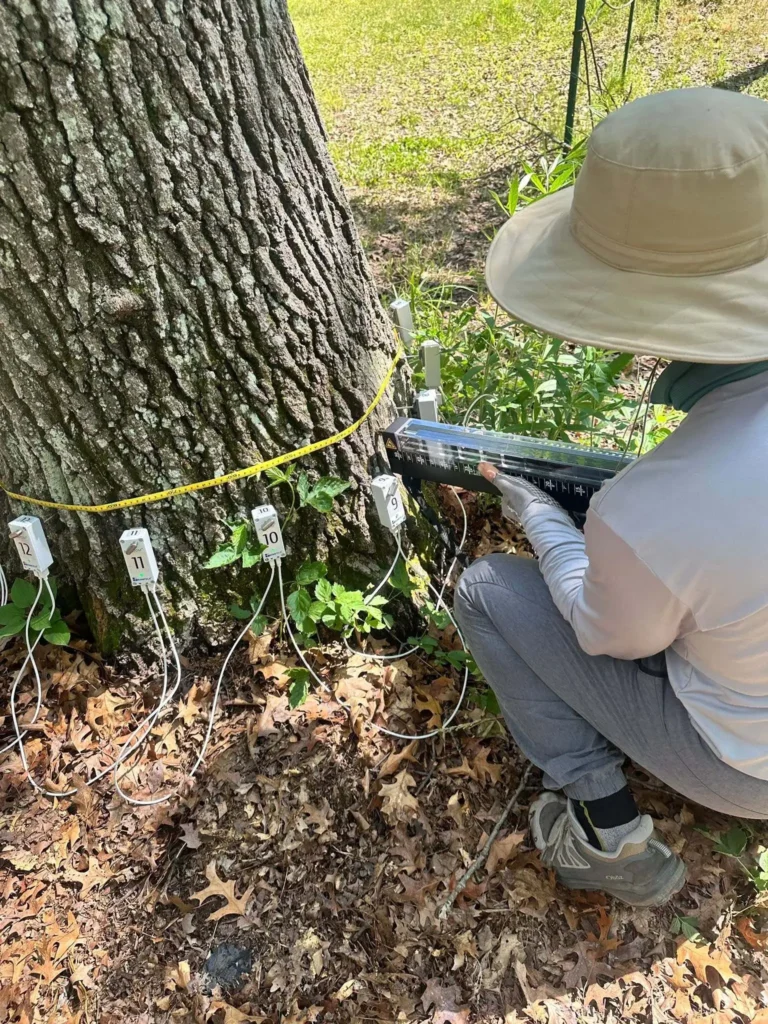
Here is how it works. A ring of numbered sensors is attached around the trunk at the same height. A sonic pulse is sent between each sensor pair and the system records how fast sound travels through the wood. Dense, healthy wood conducts sound quickly. Decayed, hollow, or compromised wood slows the signal. The software compiles these readings into a two-dimensional cross-sectional image of the trunk, essentially a picture of the tree’s interior taken with sound.
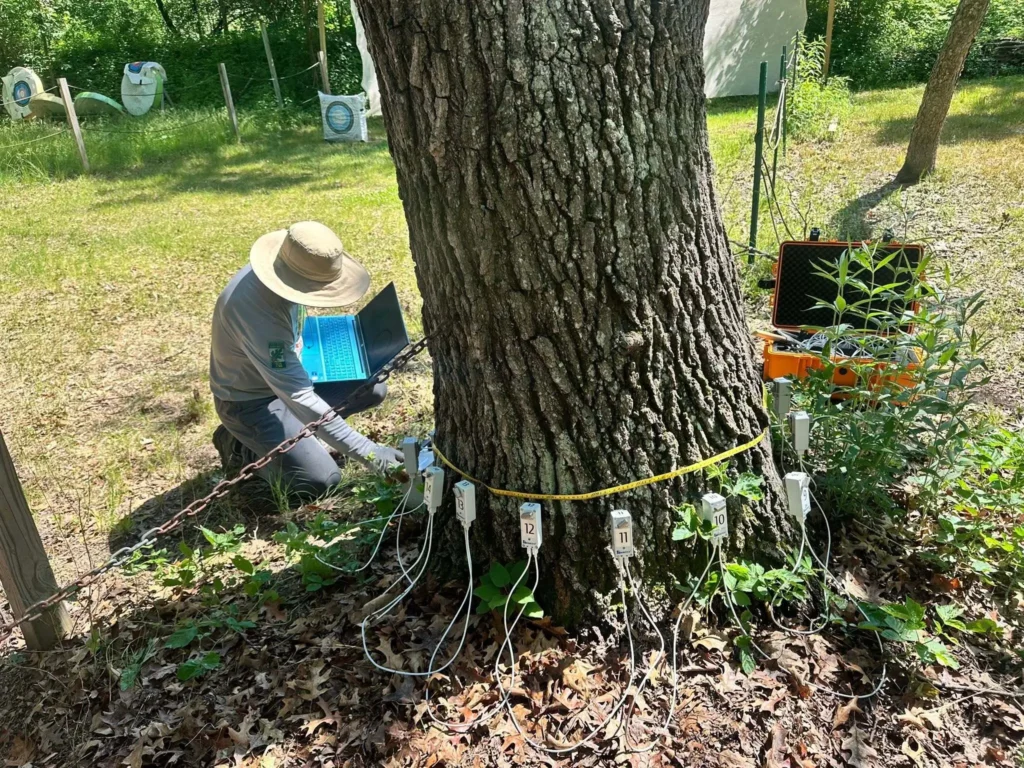
In the photos from this job, you can see 16 sensors deployed around the base of the oak, all connected to a central battery pack and data collector. Mitch reads the output on a laptop at the base of the tree, analyzing internal structure in real time. This is the same category of technology used in structural forensic engineering, applied to living wood.
This level of plant health care diagnostic capability is not standard equipment for most tree services. It requires significant investment and specialized training to operate and interpret correctly.
The Site: A Red Oak at the Center of Camp Life
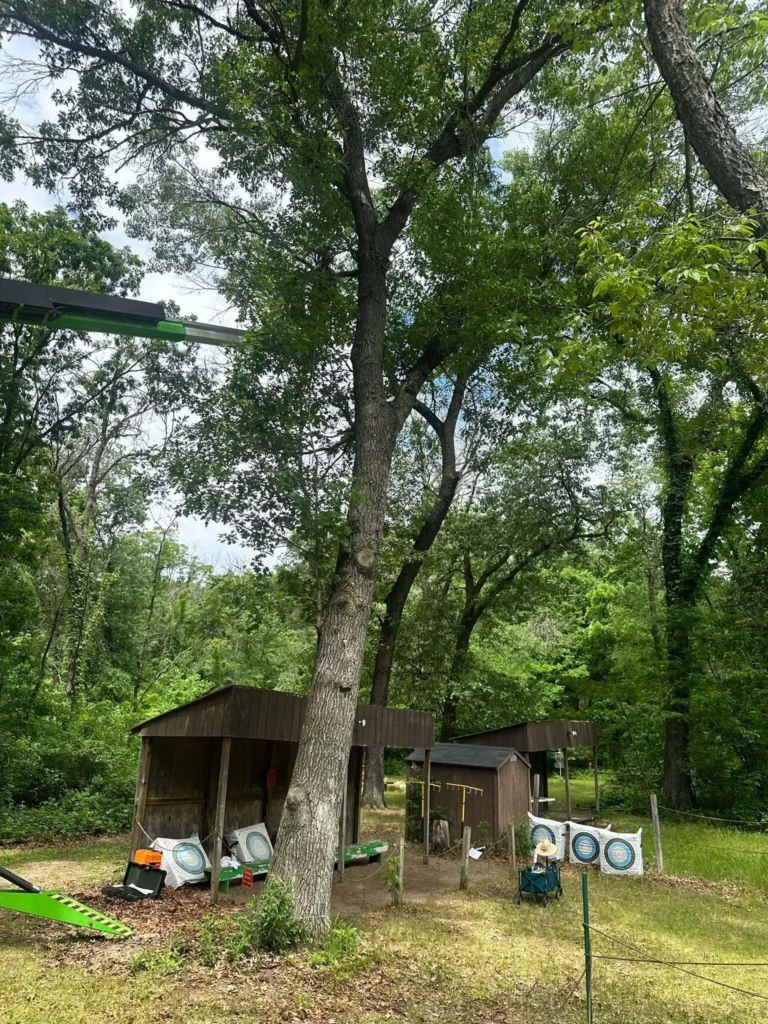
YMCA Camp Pepin is a camp and retreat facility in Pepin County, Wisconsin, situated in the bluff country along the Mississippi River. The red oak in question grows at the center of the camp’s archery course, surrounded by shooting stations and open use areas. More critically, it functions as an anchor point for the zipline system, meaning dynamic cable tension and repetitive mechanical load transfer into this tree on a regular basis.
Red oaks (Quercus rubra) are a dominant hardwood species throughout the Driftless Area of western Wisconsin. They are long-lived, ecologically important, and generally structurally sound. But like all trees, they can develop internal decay, root zone dysfunction, and structural compromise that is not detectable from the outside. A tree can appear completely healthy in the canopy while harboring significant defects at the base or in the lower trunk. Red oaks are also the primary host species for oak wilt, a vascular disease that can progress rapidly and is worth monitoring in any assessment of this species.
The combination of species, site conditions, and attached infrastructure made this a high-consequence scenario. Getting the assessment right mattered.
The Credentials Behind This Assessment
This type of work requires credentials that are specific to the task. Mitch Hoy holds three relevant qualifications for this assessment:
- ISA Board Certified Master Arborist. This is the highest credential awarded by the International Society of Arboriculture, held by fewer than 2% of all ISA Certified Arborists. It requires verified experience, formal education, and passage of a comprehensive scenario-based exam.
- ISA Tree Risk Assessment Qualification (TRAQ). A credential specifically designed to standardize tree risk assessment methodology, ensuring evaluations follow a defensible, science-based framework recognized by the ISA.
- ASCA Tree and Plant Appraisal Qualification (TPAC). Awarded by the American Society of Consulting Arborists, this reflects expertise in the consulting and valuation dimensions of arboriculture, including documentation for legal and institutional purposes.
Together, these credentials mean the written assessment Mitch produces is not an opinion. It is a professionally defensible document built on established methodology, advanced diagnostics, and the interpretive expertise to translate raw acoustic data into clear recommendations. For an institution like YMCA Camp Pepin, that documentation is the foundation for every decision about the tree going forward.
Why Most Tree Services Cannot Perform This Work
This is worth being direct about. A Level 3 advanced tree risk assessment is not available from most tree service companies, not because of lack of effort, but because of the investment required in credentials, equipment, and continuing education.
Sonic tomography equipment requires significant capital investment and hours of training to operate and interpret correctly. The TRAQ credential requires documented training and examination. The ISA Board Certified Master Arborist credential requires years of verified field experience before a candidate is even eligible to sit for the exam.
In Minnesota and Wisconsin, tree service certification is not legally required to operate a business. That means property owners and facility managers must do their own due diligence when selecting who performs a risk assessment. When a tree’s failure could injure a person, the question is not simply whether someone can look at the tree. The question is whether that person has the tools and credentials to actually know what they are looking at.
ArborWise built its practice around being able to answer that question with confidence. Our plant health care services include diagnostic tools and certified expertise that most regional providers do not carry.
What the Written Assessment Report Contains
The output of a Level 3 Advanced Tree Risk Assessment is a formal written report. For YMCA Camp Pepin, that report documents:
- Current canopy health, structural form, and all observable defects from both ground level and aerial inspection.
- Internal structural findings from the sonic tomography cross-section, including any decay columns, voids, or compression wood patterns.
- Root zone and soil conditions that could affect long-term stability.
- A risk rating based on the likelihood of failure and the consequences of failure given the site conditions.
- Specific recommendations: mitigation options, monitoring intervals, structural support systems if appropriate, or removal if warranted.
For camp administrators, this report is a defensible record of the tree’s condition at a specific point in time. It supports decisions about the zipline system, informs maintenance schedules, and provides documentation that the question was taken seriously and answered by a qualified professional.
Frequently Asked Questions
What is a Level 3 tree risk assessment?
A Level 3 Advanced Tree Risk Assessment is the highest level of tree evaluation defined by the International Society of Arboriculture. It involves diagnostic tools such as sonic tomography, resistograph drilling, or ground-penetrating radar to assess internal and root zone conditions that cannot be determined by visual inspection alone. It is used when the consequences of tree failure are high or when a basic assessment leaves questions unanswered.
How does sonic tomography work on trees?
Sonic tomography works by sending sound pulses between sensors attached around the trunk and measuring how fast the signal travels through the wood. Healthy wood conducts sound faster than decayed or hollow wood. The system produces a cross-sectional image of the trunk interior, revealing internal decay, voids, or structural compromise without any cutting or coring.
When should a property owner request an advanced tree risk assessment?
An advanced assessment is warranted when a tree is located over a high-use area, when structures or equipment are attached to the tree, when a basic visual assessment reveals something inconclusive, or when the consequences of failure include injury to people or significant property damage. Camp facilities, schools, playgrounds, and properties with large trees near occupied structures are all appropriate candidates.
What credentials should an arborist have to perform a tree risk assessment?
Look for an arborist with the ISA Tree Risk Assessment Qualification (TRAQ), which is specifically designed to standardize risk assessment methodology. For complex or high-consequence situations, an ISA Board Certified Master Arborist with TRAQ represents the highest available level of expertise. Credentials can be verified directly on the ISA website at isa-arbor.com.
Does ArborWise serve areas outside of Rochester, MN?
Yes. ArborWise serves residential and commercial clients throughout southeastern Minnesota and extends into western Wisconsin, including Pepin County. For advanced assessments, consulting work, or tree risk evaluations at camp or recreation facilities, contact us at (507) 535-9082 to discuss your site.
What is the difference between plant health care and a tree risk assessment?
Plant health care is a broad, proactive approach to managing the long-term health of trees and landscape plants, including pest management, soil health, disease prevention, and ongoing monitoring. A tree risk assessment is a specific, structured evaluation of the likelihood and consequences of tree failure at a given site. They are complementary: a risk assessment may identify health-related defects that then become part of an ongoing plant health care plan.
Conclusion
The red oak at YMCA Camp Pepin is more than a tree. It is a structural element in a recreational system that serves hundreds of people each season. Treating it that way means bringing the right technology, the right credentials, and the right commitment to documentation to the job.
That is what plant health care looks like at its most rigorous. Not trimming what looks overgrown. Not applying a treatment because something seems off. Asking the right question, deploying the right tools, and producing a written answer that holds up to scrutiny.
If you have a tree on your property that carries that kind of responsibility, we would like to help you answer that question too.
Call ArborWise at (507) 535-9082 or visit arborwisemn.com to schedule a consultation.